Warning: 18 SG rating. Children under the age of 18 should not read this post. If you are under 18, please click here.
Our motto is: If the comic doesn't make u laugh, the ugly drawings will.
The Turtle Strip
Yesterday was a pretty lousy day in most respects. In the morning, I needed to go to the bank to transfer some funds from one acct to another. I walked there only to find that I forgot to bring one of the acct numbers with me. Then we decided to go collect my wedding gown first. Only to find that the shop was still closed. So we decided to pay the cheque for the new house. Only to find that we forgot to bring the cheque out. I started to get a headache.
So we had to go back home, take the acct book and then go to the office to get the cheque and then do everything that we needed to do. We wasted one entire morning because of our forgetfulness. After all that, we needed to send our car to the workshop because it needed some minor repairs. And I still had the headache.
So at the end of the day, we walked to the workshop from our office to get our car. We waited there for an hour before realising that it wasn't going to be ready. And hence, we walked home from the office. And my head was pounding.
As I walked home, I realised that if i were to spend my time pondering over all the stuff that went wrong, I would be spending my time venting out frustrations and anger. Instead, I thought of writing about my pleasures of the day. So let's start again.
When I woke up in the morning, my spouse held my hand and wished me good morning. He peeled a banana for me for breakfast. We saw our new house again, and it seems to be going up quite nicely.
The walk home from work was very nice, we chatted all the way home and I even had an umbrella to shield me from the sun! We spent the night with friends eating shabu shabu (his favourite!) Before we turned in for the night, he massaged my aching head, brought me Panadol and water and hugged me.
Yesterday was a pretty good day. I had a good time :)
Demanding for Justice may be an Injustice as whole
0 comments Published by Mel on Monday, January 22, 2007 at 4:21 PMI have not donated any money to beggars for a long time. When I see people just sitting there and begging, I start to feel rather angry, for a lot of them are just going to take your generously-given money to buy cigarettes or drugs. For example, there is this guy with gout on his back who goes around all the churches in Petaling Jaya asking for money. He says, “Praise the Lord Jesus, the King of all Kings!” and then shakes your hand. Next he tells you that he needs money for an operation for his gout. I wouldn’t mind so much, except that he’s been doing that for the past 20 years. I have begun to doubt that he really wants money for operation. In fact, I started to really dislike people who use God’s name for begging. Why can’t they just find decent jobs? I started to believe that one should not give alms to those begging. Although some may actually need money for operation, most of these people are just lying to get money for nothing. By giving them money, we’re doing them more harm than good as we’re telling them that they don’t have to work for money. We’re saying that we will work and give them money for acting pitiful!
Additionally, I felt that I shouldn’t give money to people who would probably use it to destroy their bodies with drugs and cigarettes. My conclusion is that if they want to go destroy their bodies, let it not be with my money. Also, we all deserve what we work for. That is Justice.
But is that really Justice as a whole?
I recently came across this story, and it changed my perceptions.
There are people who actually are forced to sustain their lives through begging. There are disabled people who really need operation, and are selling bookmarks and key chains to get the money they need. Although there are many cunning people who take advantage of society’s generosity, there are many still who unfortunately, need to rely on it.
If I promote my principle of not giving alms to beggars, and if all of us really stop giving, then those who are truly in need will surely die. But those cunning ones would probably find other devious ways to get the money (i.e. steal, cheat or extort). After all, we can’t change their human nature. Am I so naïve to think that I can force them to do actual work rather than begging? If they are determined to get easy money, they will surely find other means of doing so.
Hence if I did succeed in my mission, what would I have achieved in the end? One thing for sure: I would not have gotten rid of lazy individuals who leech on our generous hearts, nor would I have changed the minds of those who are bent on destroying themselves with drugs. Their nature will probably be unchanged and thus, they find other ways. Instead, what I would have achieved is this: I would have left some poor disadvantaged individuals unattended and gotten rid of them even though they have real needs.
In other words, I would have sacrificed some good people who are down on luck without changing those people who are cunning and want free money. What a great injustice!
Unless I am able to distinguish a cunning man from a disadvantaged man, I cannot impose my narrow sense of justice without causing an injustice.
There will always be people who will take advantage of others. This has existed since the dawn of mankind. I cannot change them. But I shall also not cause more grief to men who have real grievances.
From now on, if I see a disabled man selling bookmarks for an operation or for a living, I shall check my purse for some change. If I do have some, it will go to him. I shall no longer concern myself over the cunning man whose nature is not for me to change. In contrast, I shall concern myself over the disadvantaged man, for it is within my power to change his luck.
I always thought that falling in love required a lot of effort and time to get to know a person. I had a list of criteria and needs from a partner and so, i always felt that the screening process is part of falling in love. After all, how do I love someone completely if I can't accept a certain trait?
But I was quite wrong. When I met Ye Chow, I had a long list of reasons why it could never work out between us, and why I would never love him as more than a friend. I even shared that list with my family. I knew that we would be great friends, and I knew that he was not someone I could love simply because he didn't match me in a lot of ways.
So I went along my merry way, occasionally telling him that "No, I don't want to be your girlfriend" or "No, I don't want to be your wife" whenever he brought up the subject. I told him so clearly and concisely that we were just friends, that he had almost all but given up.
And one day it hit me really really really really really really REALLY hard.
It happened to be one of those days when we were having a simple dinner in a coffeeshop after a game of badminton. I was just sitting there, eating some veggie and tofu and chatting with him. It wasn't a special dinner. It wasn't a special moment. My heart didn't beat faster, nor did I hear music in the background. In fact, I didn't even have thoughts anything like what I expected myself to have when I fall hard, you know, thoughts like "He makes me whole" or "he completes me".
In fact, all I was thinking about was how nice the moment was, having a warm meal after a tiring game. How I really liked to just sit there with him. And I didn't need anything more than that.
It was then, and only then, that it hit me. It wasn't until that moment that I truly knew what it meant to fall in love. I didn't have any overwhelming emotions. I didn't have any big efforts to put in. I just wanted to be with him, I didn't need anything more than that. I was contented just to sit there with him and watch him eat tofu (which can be rather yucky coz he tends to stuff a lot of veggie and rice into his mouth all at once). It was a very strong feeling of contentment and peace.
That was when I knew I wanted to spend the rest of my life with a man I just told something like 100000 times, "We can never be more than just friends". In fact, I told the same thing to my parents! What a catastrophe!!!!!!
The first thing I did was to tell all those who needed to know that I was in love with Ye Chow. After a week of explaining to all those involved (I shall not go into the details), I finally told my parents, who were obviously very surprised. And two weeks after I told my parents, Ye Chow proposed AGAIN (without a ring). And I said "yes", knowing fully well that we had a long road ahead of us. My parents won't get over the shock easily (only 2 weeks with him and I was telling them about marriage). I would have plenty of problems with my ex. My friends would question the speed of the whole thing. And I had to meet his parents as his girl friend! AND, we had a wedding to plan on top of all that. But, it was well worth it, just to know that I could be sitting contentedly with him. I never felt as much peace before.
They said it doesn't take more than a second start falling in love. I agree and disagree. Sometimes, for people who are dense, it takes them a few months to realise it. But it takes less than a second after it hits them to make the final decision to love someone else.
That's how I fell in love anyway.
"Many of my peers, bright and well educated have packed up and left. It’s what MM Goh called “quitters”. It’s sad but true, Singapore no longer is a place where one can hope to work hard their lives and retire graciously. It’s really the push factor. A future is something we sweat it out, build and call our own. Unfortunately, people like me, mid 30’s going on 40’s, staying put by choice or otherwise, we can’t help but feel what lies ahead is really a gamble.
To PM Lee and the Ministers, we are on a different platform. Until you truly understand our insecurity, the future of Singapore to me remains a question mark." (2 Oct 2006)
Days later, Wee Shu Min posted this on her blog:
"Derek is one of many wretched, undermotivated, overassuming leeches in our country, and in this world. one of those who would prefer to be unemployed and wax lyrical about how his myriad talents are being abandoned for the foreigner’s, instead of earning a decent, stable living as a sales assistant. it’s not even about being a road sweeper. these shitbags don’t want anything without “manager” and a name card. Please, get out of my elite uncaring face." (19 Oct, 2006)
Shu Min's blog entry caused quite a huge uproar in Singapore. She eventually took down her blog, but it didn't stop there. Popular forums in Singapore and even Canada had something unkind to say about her. Those who decided to give her a break only did so because she is "only 18 and may not know much about the real world". Overnight, Shu Min went from a smart student attending a top junior college in Singapore to being witch-hunted in cyberspace. She was hung and burnt on stake over the blogsphere despite her public apology.
I read so many comments stating that she has such an elitist view because she was born with a silver spoon and doesn't know what it is really like to have to work hard in life. I found myself pondering on a few points in this whole soap-opera-like drama. Firstly, why do we bother to lock, aim and shoot someone else's point of view? Is it important that we refute everything she says? Is it necessary to bring her to her knees over this?
She has a own value system that may differ from ours. I personally can't say I agree with her thoughts, but I don't see why I should impose my values on her. She isn't my child nor is she my younger sister. It is not in my place to "teach" her my values. If her family has that value system, and taught her just that, then it is not for us to tell her that her perspectives are wrong.
The point is this: You don't have to agree with her. But it doesn't mean you can disrespect her. You don't have to like what she says. But it doesn't mean you should argue with her, hunt her down on cyber space (to the extent of dragging up her bikini pictures) and embarrass her. Why react with anger, disappointment and disgust over someone else's view of life? Why judge her?
By being harsh and critical towards another person, we invite harshness and criticism over our own actions. If we judge another, we will automatically judge ourselves, and our loved ones as well. We open the door to suffering because we thought what we are doing or saying is right. Even if our thoughts and views may be on a higher moral ground than Shu Min's, we drag ourselves to suffer anger and criticism along with her if we are to judge her comments or her upbringing.
The fact is that we can't change her upbringing. If she is born rich, that is her fate. By being overly-critical on her life and her so-called elitist comments, we may succeed in muzzling her. But we will not change her perspectives in life that have been ingrained into the core of her value system. By arguing our well-thought-out and morally-and-politically-correct case, we succeed only in making ourselves feel superior at her expense.
You know the infamous story about pointing a finger at someone (three fingers would point back at ourselves). The truth is that if you judge someone based on what they are wearing (Gucci shoes...check, Louis Vuitton bag...check, Chanel suit...check), you will need to spend a lot of money to dress up as well. Whether you realise it or not, you are suffering. You will eventually always feel insecure whatever you wear, or always feel that you may not have enough. Similarly, if you judge someone based on the house they live in, you will always be critical over the size of your own house.
If we criticise Shu Min today, we will be criticising ourselves tomorrow. After all, we have to keep to the same moral standards that we set for others (or in some cases, we may feel we need to exceed them). Why give ourselves so much pressure? Will such conditions really spur us to grow into better people? If you rear one horse in a wide and peaceful meadow, and another in a crowded and busy city, you can probably guess which horse will be the healthier (and happier) of the two. I prefer peaceful conditions. And I wish for Shu Min, and everyone else, to find peace in their tiny little portion of this earth.
Why You Shouldn’t go to Bed Angry
0 comments Published by Mel on Tuesday, December 12, 2006 at 2:28 PMI must confess, I had a small misunderstanding with Ye Chow recently. He was reading a book which is a compilation of short stories written by some guy a few centuries ago. The stories describe the daily lives of him and his neighbourhood, as well as some rumours and strange happenings. It sounded very interesting, and I wanted to share the moment with him. The problem was that he was reading a Chinese book and since I can’t read a word of Chinese, I asked him to translate for me as he went along.
He took it as me distracting him and not letting him read the book. In the end, he went to the hall area to read. And I got pretty mad, so I went to sleep.
And I had a really awful dream.
***
Ye Chow and I were in our car, driving along the road to get to a shopping complex in the heart of Kuala Lumpur. We noticed that there had been a bad accident. There were a few cars at the side of the road that seemed very badly damaged. In fact, one of them was lying on the pavement in two pieces!! And there were bundles of clothes everywhere. I averted my eyes since I can’t bear to see accidents. It was then that I noticed something really weird. The road that we were driving on had pools of red puddles. In fact, as we travelled further, the red puddles were larger and larger until it appeared as if we were driving on a red road. There were more damaged cars, and horror of horrors, it finally dawned onto me that those sack of clothes that were increasing in numbers were actually mutilated bodies! I wanted to shut my eyes, but my curiosity was so strong that I couldn’t help but look harder. Some bodies appeared to be cut into two, which was why I couldn’t recognize them as human corpses. Some were strewing from the damaged cars (which also appeared to be smashed into two), while some were pretty much scattered in smaller pieces all over the road. I could even smell blood.
I was so horrified that I didn’t notice Ye Chow’s reactions until he spoke up. He wanted to stop at a nearby shop and just stay indoors. He didn’t think it was a good idea to continue driving on the road where the number of “accidents” seems to be increasing. So we stopped and walked into a small grocery shop. There, we found a lot of people huddling together watching a small TV set in the corner of the store. Most of them had a look of disbelief, while others had a really blank stare. The owner of the shop, a big Indian man behind the counter, told us that a gigantic-size tractor just went by 20-30 minutes ago. That tractor was attacking other vehicles. He had heard a lot of screaming and screeching of tyres, and the sound of metal crunching. On the TV set, a special news report on TV3 had pre-empted all other programs.
Apparently, a couple of teens had stolen an experimental vehicle from the Agricultural Research Institute. It was indeed a gigantic-size tractor, designed for harvesting paddy (rice). It had a detachable loader in the front and backhoe at the back, which would convert the tractor into a very strong vehicle for construction purposes. The machine was so powerful that it purportedly could do the job of 3-4 other tractors. The only problem was that in the hands of two reckless teens on a murderous spree.
A video feed from the news station helicopter showed the tractor “attacking” motorcyclist and motorists along its path. While many motorists can speed away in their far more powerful cars, many motorcyclists were not so lucky. The backhoe had an extendable arm that could easily nudge the motorcyclist to ground, after which the two boys would drive over the wounded and kill them. They also used the front loader to damage any cars that were parked at the side of the road.
The scene was so awful. On the TV screen, we could see people dying. Outside the window of the shop, we could see so much blood and corpses. I felt so nauseated. Ye Chow told me we couldn’t stay in the shop forever, as more and more people were coming in. We should probably get into our car and go home where it would be safe. I was so afraid to go out that I wanted to object vehemently, but when he walked out, I found myself following after him very numbly. Although I was screaming inside, I couldn’t utter a word. I just couldn’t find my voice to object to driving out there where the teen boys were still on the loose.
Throughout the drive home, I would find my heart pounding and ears ringing at every turn. I wanted to look out at every junction, but I found myself looking the opposite direction. It was as if I was two people at the same time. One person wanted to be cautious, alert and careful. The other person wanted to hide away, deny the danger, and do nothing.
And suddenly, the world seemed fake to me. When I looked out the front windscreen, I saw a world of colours that were not real. I saw that life was always going to end in death. I saw that whether I died under a tractor at the age of 25 or on a hospital bed at the age of 80, it would not make much of a difference to the world. These colours were not real, nor permanent. I would take nothing of it with me when the tractor comes. I turned to look at the man driving beside me. He looked so unfamiliar now. Just another human body next to me. I did not recognise his face anymore. But when he glanced at me, I recognised his presence. The face meant nothing.
Outside, the road was still red. There were police cars and ambulances going the opposite direction towards the city. Yet I didn’t feel like I was a part of the world anymore.
And then I woke up.
***
The first thing I did was to get Ye Chow to apologize to me and sort out the misunderstanding. You really should never go to bed angry.
Chia-Shan and his first light
1 comments Published by Mel on Thursday, November 23, 2006 at 11:07 AMThis is a classic story (Taoism) that was very well translated. I leave it here to share it with you:
Chia-Shan and his First Light
One of my favorite Zen stories is that of the Boat monk. The story teaches the dharma and illustrates the high Zen literary style.Seems that a group of monks attained some degree of the Tao under a famous Zen teacher, Master Yao-shan. One of them was Teh-cheng and his dharma brothers were Yun-men and Tao-wu. Master Teh-cheng knew he didn't have the personality to teach a large number of people or run a monastery, so he told his brothers to send him someone of exceptional talent when they found one rather than open up a teaching center himself.
As is the rule, his job would also be to transmit the dharma to a qualified student if he could find one, but without a teaching center, he had no way to attract a student. Therefore his dharma brothers would have to send someone who had the karmic affinity with Teh-cheng for awakening. So he told them, "You know where I am staying. If you find a student of sharp potential, send him to me so that I may transmit the dharma."
Years later, it just so happened that Teh-cheng's dharma brother Tao-wu was attending a lecture by a famous monk, named Chia-shan, who already had a great following. Chia-shan knew all about the dharma and was extremely eloquent. He could respond to every question with the proper words, and yet he lacked the dharma eye...he lacked any true stage of attainment. Ask him any question and he could respond with the right words ... but without the dharma eye, everything was actually wrong because it could enlighten no one. He knew the words but did not know the real meaning -- he had not achieved it.
His case was like the intellectuals today who study the Bible, Koran, Buddhist sutras, Torah, or any such book or sets of books, know all the perfect words to use so that they sound as if they are in accord with the traditional teachings, and yet everything they say lacks any touch with True Reality. Why? Because those folks have no cultivation attainment themselves. They are dogma literalists rather than enlightened sages. So while they may be intellectually brilliant they are spiritually bereft, and cannot lead anyone to liberation.
That's the state of the world. That's 99.999999999999% of teachers and religious professionals out there.
So while attending the lecture, Master Tao-wu just kept himself quiet and concealed, but he snickered when Chia-shan answered a question correctly ... in order to attract attention. After it was over, Chia-shan respectfully approached master Tao-wu and asked what mistake he had made that his elder had done so.
Tao-wu replied, "You answered correctly, it's just that you've never been taught by a good teacher. I never explain things. If you want to learn, you must go to visit the boatman's place at the city of Hau-ting (where the Boatman Monk Teh-cheng was staying)."
Now because he really was interested in self-improvement, Chia-shan set off right away. This, in itself, shows he was of extraordinary character and not too full of himself. Chia-shan was right in theory, but did not have a real experience of the dharma, yet didn't know it. He thought he was right, but also suspected that he was wrong, that he was missing something though everything he said was correct and according to the scriptures. Amazingly, he was willing to take advice and was anxious to find the answer despite already being established and having a great reputation, so off he went. Would you do that? Now at the location, the dharma brother Teh-cheng had settled into a job ferrying people across a river, and had done so for several decades waiting for a good student. No one knew of his high stage of attainment. When the young monk arrived, with one look he knew that he had been cultivating and had some ability, but needed to be awakened to a true direct experience of the dharma. He needed a real, direct experience of the Tao. He knew all the right words, the sutras, the dharma and so forth, but he was clinging to all these explanations and his conceptualizations. He had become an intellectual master rather than reality master. He could not let go of them to realize no-self, no-ego, emptiness. Therefore he had not attained the Tao.
Upon meeting young master Chia-shan, who knew all the correct words but had no direct taste of reality, Teh-cheng opened up the conversation by asking, "What temple do you dwell in, oh virtuous one?"
Chia-shan answered with words that point to the Tao, though of course he did not have that stage of attainment: "I do not dwell in a temple. Dwelling is not like it."
Why did he say this? Because the original nature is not a state, and if you dwell or abide in any state it is NOT the Tao. Chia-shan was saying he understood the Tao by answering in such a way because a regular monk would simply have mentioned the name of his city or monastery.
The boatman then asked, "It is not like what?"
Chia-shan once again correctly answered the correct intellectual response, "It is not the phenomena before our eyes." Because Chia-shan kept answering correctly, but without without possessing the true dharma experience himself, it was like someone who would respond with the right scriptural retort from the Bible ... though everything said was everything right and you could not find any fault with it, you could tell they were wrong. I'm sure you've had that experience because it is hard to explain.
A little bit disgusted at these canned responses, the Boat monk Teh-Cheng then asked, "Where did you learn all this (way of answering)?"
Chia-shan answered, "It is not something that the eyes or ears can reach," meaning it ultimately comes from the Tao. This time Chia-shan replied in such a way that you could take it as a smirk, with the hidden meaning being, "I know this and you don't? Who are you that you don't know these things?"
With that response, the Boatman monk then uttered a famous line, "A fitting sentence can be a stake that tethers a donkey for 10,000 aeons."
In other words, if you just cling to scripture, or intellectualization, or the words of this or that holy text without arriving at a genuine experience of the true meaning, if you don't experience the original nature, you will tie yourself up in ignorance (non-enlightenment) for aeons and never become free. Why? Because you cling to the intellect, in which case you are wrong. Words will not save you, scripture will not save you. Only cultivation practice and realization will save you!
How many people follow this pattern today? They quote the Torah and cling to it, all the while being correct in words, but WRONG. They cling to the Bible, reciting verses and sentences correctly, and yet they lack any attainment or any means for getting anywhere. They cling to the Koran, the Buddhist sutras, Taoist works and they are all wrong. They never fathom the meaning of the texts. They never reach enlightenment or samadhi or any genuine stage of attainment. They can talk about things all they want, but these are just intellectuals rather than spiritual leaders, people who know a lot about religious things but cannot lead you to the Tao. This is all you find today in churches, temples, mosques and monasteries. No one has the enlightenment eye, or even an inkling that it exists ... and they are even oblivious on how to get there. "
A fitting sentence can be a stake that tethers a donkey for 10,000 aeons" -- Master Teh-cheng was saying that Chia-shan was clinging to the dharma and relying on verbal tricks, and that this was stupid. It would get you absolutely nowhere on the path of true spiritual practice and striving and progress. It was just mental games, verbal tricks and memorization. REAL accomplishment comes from the cultivation practice of letting go and detaching from the realm of mentation to get to the substrate underneath it and EVERTHING. "
A fitting sentence can be a stake that tethers a donkey for 10,000 aeons" ... Chia-shan was stunned at this reply.
Zen master Teh-cheng then said, "The fishing line is hanging down a thousand feet, and the intent is deep in the pond. You're just three inches away from the hook. Why don't you say something?"
He was saying, "You've done so much meditation work your life and are so close you're ready to reach it. Why not say something expressing your original nature?" Chia-shan was standing there, his mind emptied a bit because of the shock, and was just about to say something intellectual again when the Boat monk hit him with his oar and knocked him into the water.
Wham!
Chia-shan had just been ready to open his mouth again and say something that was in the scriptures when the Boat monk knocked the daylights out of him and he flew into the water.
As soon as Chia-shan's head popped up above the water again, the Boat monk once again shouted, "Speak! Speak!" and just as Chia-shan was about to open his mouth again, Wham! ... the Boat monk hit him again.
Now if you've had any sudden taste of emptiness where everything empties out (a religious experience), you can understand what happened next. Here's a man with a belly full of learning and it's all suddenly knocked out of him. He's been thrown into the water, he's worried for his life, and all his false thoughts have been whacked away.
That's the method the Boat monk used with Chia-shan.
Chia-shan could talk about anything in the dharma ... Consciousness only, the three Buddha bodies, skandhas, True Thusness, prajna wisdom, EVERYTHING. He understand all this but couldn't let go of it, so the Boat monk knocked him into the water to help him let go of everything he was clinging to. Even so, when asked to speak, Chia-shan was ready to spit out the dead scriptural words again, so Teh-cheng hit him again. When for the third time his head rose above the water, this time his mind had emptied out and he and become enlightened, so Chia-shan quickly nodded his head three times in quick succession to show Teh-cheng he had got it and he didn't need to be hit again.
Of course you cannot just hit someone to enlighten them. Don't think it's so easy. Chia-shan not only KNEW the dharma intellectually, but had spent his life meditating and had achieved some degree of emptiness, but just couldn't let go of his intellectualizations to see the path, to see the whole thing. He was close because of his previous attainments in meditation, but still clinging. He already had achieved a deep basis of cultivation beyond just studying, because of prolonged meditation work, and that basis is why Tao-wu sent him to the Boat monk. He was prepared....don't think someone can just whack you or slap you and you get it. Without countless years of meditation work, that would just get you a lawsuit today.
Master Teh-cheng was able to transmit the dharma only because Chia-shan had already spent years mixing practice with study. Master Teh-cheng was able, through the expedient means of whacking him, to help Master Chia-shan let go of everything and see the Path, see the Tao, realize self-enlightenment. If Master Chia-shan had not been a meditator, however, none of this would have been possible. So don't think that just studying scriptures and sutras -- of any kind -- will do it. You have to do the meditation work, open up your chi channels, chakras and so forth. You have to cultivate samadhi, but none of that is the Tao. It's just a preparation because those are all still illusory realms and false stations. They are not ultimate or supreme. They are there to help you clear out in a progressive sense, but when you reach enlightenment there are no stages -- you just let go of everything in one fell swoop. That's why it's called breaking through the conception skandha.
Upon being hit with the oar when in the water, Chia-shan GOT IT. His years of preparation and study, together with the Boatman's excellent skillful means, enabled him to let go, empty out and see the Tao. If you know the theory, that's why the story is so beautiful, so wonderful. But then, while still in the water, Chia-shan asked, "If you throw away the hook and line, what is your intent, teacher?"
In other words, Chia-shan then had doubts and asked about functioning. He was asking, "What about the methods for making an effort in the realm of existence if everything is empty... What do you do about them?"
Master Teh-cheng replied, "The fishing line hangs in the water, floating to set the meaning of existence and non-existence." In other words, don't talk of emptiness and don't talk of existence. Neither is right, and thus you don't cling to either and you can do what you want independently. You are free and liberated. Cause and effect still operates amidst phenomena, but you do not cling to them or the process. You realize the inherent fundamental emptiness of phenomena but you do not cling to it either. You are independent and free.
Master Chia-shan then said, "Words carry the mystery but they have no road. The tongue speaks without speaking." In other words, speaking is the same as non-speaking, emptiness and existence are equivalent to one another.
Master Teh-cheng was VERY happy at hearing this because then he knew Chia-shan had got it. He knew that Chia-shan had finally realized the Truth and was speaking from experience rather than from some scripture he had memorized and studied. So Teh-cheng then said, "After having fished through all these rivers [having piloted this ferry day after day for decades wanting to carry someone over to the other side], I have finally encountered a golden carp [enlightened person].
Chia-shan covered his ears at hearing this, and master Teh-shan said in response, "That's right, that's right!"
Then he told Chia-shan, "From now on you must leave no tracks where you hide yourself. But you must not hide yourself where there are no tracks."
He expressed in a high literary style many meanings: that Chia-shan must continually cultivate that state of no-thought/emptiness he had just achieved wherein there are no tracks. Furthermore, he must go somewhere where no one knew who he was, and leave his fame behind, and thus go into hiding in order to finish his cultivation. He also said that Chia-shan must not remain clinging to emptiness either, for that was also wrong.
The Boat monk then continued, "I was with Zen master Yao-shan for 30 years and I only took away this which you have just experienced/realized. Nothing more. You have just attained it. This is the meaning of all the teachings and nothing more. It's nothing else either than experientially realizing this. In the future you should not live in towns or villages but go deep into the mountains, find one or two people to continue the teaching and do not let it be cut off."
Chia-shan was out of the water by this time, and since the dharma had been transmitted, he started off to return home. The whole thing happened just this quickly, the dharma had been passed, and there was nothing more to be done. But for a moment Master Chia-shan doubted that was all and so he turned around, wandering if there was something else he was missing, if it all came to just this?
Upon seeing this, Zen master Teh-cheng shouted back to him, holding up an oar and saying, "Did you think there was something else?" Then he capsized the boat and disappeared under the water to show there was nothing else. You see, if you cling to all the pageantry of Tibetan Buddhism, you are wrong. It's just an expedient method created to help you REALIZE THIS. If you cling to the Torah or Bible, you are wrong. It's just to help you lay a foundation so you can experientially realize this. Nothing in the universe is absolute. The wind, the rocks, the flowers are all singing the dharma to help you awaken.
The meaning of Christianity, Judaism, Islam, Buddhism, Sikhism, Taoism, Confucianism, yoga, alchemy and all the religions is to realize our fundamental nature. All the ceremonies, scriptures, prayers, and practices are to enable you to experientially realize THIS. That's the purpose of all the scriptures.
What else did you think it was about? Some ceremony or special belief?
Now you finally know. Cultivate!
Get to know Malaysia - Wesak Day festival
0 comments Published by Mel on Wednesday, November 22, 2006 at 11:04 AMOn the morning of tis day, Buddhist devotees will gather in temples throughout Malaysia, wearing simple clothing with no make-up or jewellery. Drums are beaten to announce the arrival of this day, and devotees gather to release doves and to offer prayers. Alms are given to monks and free meals to the needy. Devotees gathered in temples and halls would read the holy scriptures and listen to the monks recite ancient stories of Buddha. Candles are lit and prayers are offered.
 Monks offering prayers and beating drums
When u enter the main hall where devotees gather, the first thing you will probably notice is the "stage" where statues of Buddha are placed and a couple of monks would be praying (chanting). Their sweet voices fill the air, setting the prayerful mood for the place.
 Sprinkling water onto the statue of Buddha
Little fountains were also set up around the hall where devotees would take turns to sprinkle some water onto a miniature statue of Buddha and offer prayers. I suppose this is quite similar to the Veneration of the cross during Easter celebrations. I also noticed some devotees lighting candles before offering some prayers. I asked my companion what this ritual means and was told that it represents a continuing journey towards enlightenment, whereby the heart was "dark" before and now a light shines inside.
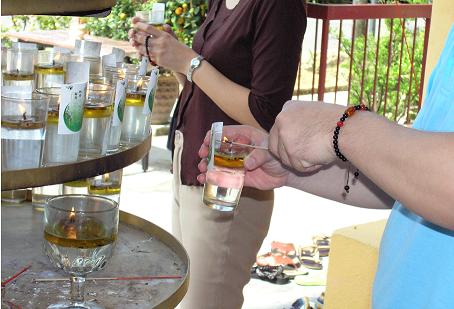 Lighting Candles
 Placing the lit candle onto a tower of candles!
In another area, a little stream was created and channeled to circle some statues of honourable figures in history. Devotees walk slowly through the little stream; some chanting, and others in silence. The children, of course, were happily playing...I supposed it's like a mini Disneyland for them, with the fountains and streams and all....
 Walking on stones through a stream in prayer
So if you ever have a chance to visit Malaysia during Wesak day, be sure to drop by the temples and Chinese halls and you will find a lot to learn!
Imagine you are a young 16 year-old walking through a HUGE field of red flowers. After about 10 steps, you see an extra-large red flower. You are very attracted to it. You bend to pick it, but you find it has thorns. So you give up on the idea.
You continue walking along and come across a cute yellow flower with 3 petals. You bend to pick it. You feel happy holding onto a nice flower. You continue walking and after about a mile, the flower started to smell funny. You ignore the smell, but it gets worse and worse, so eventually you toss it away. Now you are flowerless.
You continue walking and walking and find another flower, this time blue with six petals. You happily pick it up. But after walking a bit, you find that you don't like the colour blue after all. After walking amidst flowers for so long, you have come to decide you prefer white flowers with five petals. So you toss your blue flower away and begin searching for the flower you have in mind.
You walk everywhere, looking left and right. After roughly 20 miles of walking, you finally found the flower that fits your expectation. Happily you pick it up. It even smells great. It is a large flower with 5 perfect petals. You continue your journey across the field of flowers, convinced that you have the right one. As you walk and walk, the flower begins to wilt. But it still looks ok, and you think you may be able to make it back home in time to save it by putting it into a vase. So you begin to run. The hot sun beats down and your flower is wilting faster than you can run. You are so desperate that you try to provide it with some of your saliva to extend its lifespan. Unfortunately, it dried up and shriveled. You continue holding on to it, hoping that it will go back to being the wonderful flower it was. But after walking for another 30miles, you realise that it is futile. What you could have done, you already did, and it didn't stop the flower from wilting. Perhaps it is better to let it go.
Dejected, you placed the dead flower on the ground where you are standing and pick up the closest flower you can find. The flower is reddish, with pink tips on each of the six petals. You continue walking across the huge field, holding the new flower. You walk and walk and walk and as you are making your way to the end of the field, you start thinking about the floweryou just picked. You don't really like red. You don't mind pink. But you are making this journey with this flower because you want to have a flower. It feels wrong. Eventually, after 20 miles of journeying with the red flower, you let it go.
Now you decide that maybe none of the flowers are worth bringing home, or maybe you are just not very good at keeping flowers in your hand. You press on, hoping to eventually get off the field. After another 20 miles of non-stop walking, you take a short break. As you sit there, you notice another white flower with 5 petals nearby. It didn't look anything like the earlier white flower but you like it anyway. You stare at it for a while, and then you pluck it and hold it in your hand. Then you continue along your journey.
The long journey across the field continues, but you found new ways of keeping the flower alive. Your efforts work well with the flower, and it bloomed. When you finally reach the end of the field, you don't really notice.
Two monks had to travel to the nearest town to buy some supplies for their temple. Since their temple was quite secluded, they had left their temple at around four in the morning. They walked slowly to the town, and arrived at 10am. After buying all that was needed for their temple, they started making their way back around 11.
One hour into their journey home, they came across a river. They decided to stop for a while to take a short break. They drank their water and sat down next to the river to rest their tired legs. Just then, a young lady walked towards them. She was a beautiful lady, with fair porcelain-like skin and willowy body. She looked distressed. She wanted to cross the river, but she did not know how to swim! So the elder monk told her to climb onto his back and he will carry her across. She was still apprehensive that the river might sweep her away when they are crossing. So he told her to hold on tight to him.
As they were crossing the river, the second monk, a young chap, looked over at the elder monk. He was aghast to see the young lady holding so tightly to his companion, who also happened to be his superior in the temple. Her body was pressed onto the elder monk’s back and her bosom was pushed up onto the neck of the man. His face was so very close to her bosom! This was unacceptable!!! As monks, they were not supposed to touch women! And here his mentor is practically making love to the young lady!
Just then, they reached to the other side of the river. The elder monk set the young lady onto her feet. She thanked him, and continued along her journey. The two monks went a different direction from her, back to their temple. As they continued their walk back, the younger monk kept thinking about how the lady and the elder monk held on to each other as they crossed the river. The elder monk is such a corrupt monk! He is a lecherous man! All his teachings were tainted, as he couldn’t even keep to the most basic of rules which was to stay away from women!
The more the younger monk thought about it, the angrier he became. He started questioning everything the else monk had been doing up to that moment. He was repulsed by all the words and interaction they have had. He couldn’t imagine going on as a apprentice monk under the supervision of such a man. As they approached the temple gates, he turned to the elder monk and told him that he wanted to change superiors.
The elder monk was very surprised. He had thought they were doing well, and could not understand why the younger monk wanted to change superiors all of the sudden. The younger monk, his face red with anger and embarrassment for the elder monk, told him that he was very improper to carry the young lady that way. It was not right, it was against their teachings, and it showed his weakness and lust for women!
The elder monk looked at his student compassionately. “I had put the young lady down by the river four hours ago,” he said, “But you have carried her until now. What a pity!”